

Credit : Joe Dempsey
About David Maxwell
|
The Early Years Born March 10, 1943 in Waltham, Massachusetts, David started studying piano at 8 years old, first in Washington, D.C. and later in Lexington, Massachusetts. In high school, he had an influential teacher, Sol Skersey, who had played with Vaughan, Moore and others on the road and who David said sounded like Art Tatum. Skersey introduced David to modern classical music and jazz and taught him how to improvise. Jazz was David’s first love. From his own words, “In high school, maybe the 9th grade, I got really sick and needed to stay in bed for a couple of weeks. My mother brought home from a supermarket each week a new record from the RCA History of Jazz series. They featured many of the great names in jazz from the 1930s all the way to Charlie Parker.” Totally unrelated to his love of jazz and also a little known fact, was that when David was in high school, he played clarinet with the high school band and orchestra as well as sang in several Gilbert and Sullivan operettas that the high school produced annually. While in high school, David met Alan Wilson, who went on to national fame as the harmonica player with Canned Heat. They frequented record stores all around Cambridge and Boston that had listening booths, and listened to everything from Ravi Shankar to Thelonius Monk. David, Alan, a trombonist at the time, and a drummer named Dave Potter had jam sessions in Lexington. They concentrated on soul jazz: Bobby Timmons, Cannonball Adderley, and Fathead Newman. Alan was also into early New Orleans music and pre-WWII blues. After high school, David attended the University of Rochester and the Eastman School of Music. While there, Alan sent him the album The Best of Muddy Walters which David listened to over and over again. Soon after on a year abroad in Paris, David attended a concert featuring Muddy Waters whose pianist at the time was Otis Spann. In David’s own words, he wrote that he was completely overwhelmed by what he saw and heard. “Spann’s style of piano playing – his rapid right-hand flurries, his completely bluesy, soulful, right in the gut playing – was something I hadn’t seen before.” The 1960s David left college shortly after his return from Paris and returned to Boston. He started hanging out with agent/producer and finder of old lost bluesmen, Dick Waterman. He met many blues legends like Son House, Skip James, Mississippi Fred McDowell and a young Bonnie Raitt. At the time, David started playing with some local blues bands such as the Caldwell-Winfield Blues Band, and also the J. Geils Band (pre-Peter Wolf). His interest in Chicago-style blues deepened and he would always go to hear Muddy Waters whenever he was in town. His friendship with Otis Spann started in 1966 and lasted until Spann’s death in 1970. Discovering and connecting to Otis Spann in his twenties changed the course of David’s musical direction. He never gave David a piano lesson, David would just watch and maybe show Spann something and ask for advice. David later said, “The touch he had on the piano was so hard to duplicate. It took me a long time to get that right. He brought a certain depth, a kind of sensitivity and an incredible rhythmic sense to his phrasing and his lines. It was a combination of his touch with a combination of tones, runs, patterns, rhythms and phrasing.” David absorbed Otis’ rhythmic sense, deft use of both hands, and ability to shine while performing in a band setting – complementing the others, allowing the music to breathe, but still attaching a personal touch to the music. One night when Otis was sick, Muddy asked David to play with the band for that night’s performance. David had a friend who could reserve student lounges at MIT after hours where he could play as late as he wanted with whatever musicians were in town. One time he had back-to-back pianos set up for Otis and himself and drew a big crowd. In 1969, David was teaching a federally funded summer arts program in Boston. He was able to get Spann and Fred McDowell there to play for a class David was teaching at 10am, which was not the usual time for them to be awake. Muddy was also very gracious to David during his teaching stints and would come and perform for David’s classes. During these years, David was a member of Luther “Snake Boy” Johnson’s band, and played club dates with Mojo Buford “David Maxwell is the only piano player out there keeping that Otis Spann sound alive.” -John Lee Hooker The 1970s In the early 1970s, David was playing in a group called The Boston Blues Band with Bob Margolin. One night he and Bob went to hear Freddie King at the Jazz Workshop in Boston. King had an organ player but not a piano player. David got his nerve up to ask Freddie if he could sit in and Freddie liked his playing so much he hired him to go on the road the following month. David worked with Freddie for two years and they toured the US and Europe appearing at the 1973 Montreux Jazz Festival in Switzerland, the Ann Arbor Blues Festival and Madison Square Garden as well as many club gigs and blues festivals. There is live footage from that time that is available on YouTube. David recalled that Freddie could be a tough boss. David acknowledged that he was “young, out there on the road for the first time, doing all the things that blues musicians do – drinking, chasing women.” Freddie would levy a $50 fine for being too rambunctious or whatever other infraction he thought David had done. They traveled in a beat-up old Greyhound bus and a seat in the back had been knocked out to put in a piece of plywood for a poker table. “I’d sometimes see my salary going down the drain at that card game,” David wrote. David joined Bonnie Raitt’s band in 1974 for two years where he came in contact and played with Sippie Wallace and Arthur “Big Boy” Crudup. During that time, he recorded with the Nighthawks from Washington, D.C. and appears on three of their Adelphi records. In the summer of 1975, David joined up with some East Coast blues musicians in Boston and was part of The Rhythm Rockers, led by John Nicolas on guitar/vocals. Other members were Kaz Kazanoff on tenor sax/vocals, Frannie Kristina on drums/vocals and Johnny Ace on bass/vocals. They played regularly at The Speakeasy in Cambridge and backed up Big Walter Horton, Boogie Woogie Red, Johnny Shines, Robert Lockwood Jr., Hubert Sumlin and others when they were in town, When The Rhythm Rockers broke up, David joined James Cotton’s band in 1977 for two and a half years that featured Matt Murphy on guitar. After that he played with Buddy Guy and Junior Wells for several NYC concerts. “David Maxwell and Otis Spann are the baddest two piano players I know.” - Junior Wells David did not stop seeking out pianists from the pre- and post-war years. He became close friends for twenty years with Pinetop Perkins, the pianist who was in Muddy Waters’s band for many years. “Pinetop had a tremendous sense of phrasing, a certain rhythmic and spatial emphasis which is very soulful.” Sometimes Pinetop would stay at David’s house when he was in town and they would hang out in the afternoons before Pinetop’s gig. David was also influenced by Charles Brown and Sunnyland Slim with whom he formed a close relationship. David admired Slim for his driving intense style, and as David wrote, “…his jagged lines and a very deep delta sensibility.” David also was close to Memphis Slim who he described as “…so prolific and powerful.” For many of the greats he could only study their recordings. David wrote, “There’s Johnny Jones with his fleet right hand patterns. Big Maceo Merriweather with his two-hand foundation. The real old-timers, Pinetop Smith, Montana Taylor, CowCow Davenport, I do their stuff. Then there are the boogie-woogie masters: Meade Lux Lewis with his rich chords, his whole sense of rhythm and drive, Albert Ammons with his killer left-hand and his commanding presence…Pete Johnson’s touch, his figures, and dynamics”. The 1980s Back in Boston from 1983-89, David led the house band at Nightstage in Cambridge. He brought in and backed up Eddie “Cleanhead” Vinson, Jimmy Rogers, Otis Rush, Rufus Thomas, Lowell Fulson, Ronnie Earl, Luther “Guitar” Johnson, Jimmy Witherspoon, John Hammond Jr., Charlie Musselwhite and many others. He recorded with Otis Rush in 1989 and toured Japan with him twice. He formed his own band, “David Maxwell and the Blues Wizards” who backed up Albert King, Lowell Fulson and Hubert Sumlin when they came to Boston. He also did festival tours with Buddy Guy, John Lee Hooker and Johnny Barnes. Starting in 1980, he spent time in India, Morocco, Tunisia, Thailand, and Indonesia meeting local musicians and recording their music. He was very interested in the music and instruments of different cultures. His house was filled with gongs of all sizes, wind chimes, Islamic double-reeded instruments and other exotic folk instruments he collected during his world travels. “I’m just in love with sound, period,” he wrote. “I’m intrigued by how sound affects our spirit and our whole psychology. I love exotic sounds, overtones, spatial sounds and different ways of organizing sounds in a textural way, in an architectural way, in a sculptural way. Eastern music really just kind of grips me.” The 1990s and 2000s David had a long and close friendship with guitarist Ronnie Earl and they actually shared the same birthday ten years apart. David always said that they shared a certain approach to the blues that conveys depth and spiritual intensity and that they played together very well. They played together starting back in the 1970s and in 1990, he joined Ronnie Earl and the Broadcasters for two years as their full-time pianist. He performed on five different albums with Ronnie and toured the US and Europe. In 1991, David and Peter Wolf recorded a tune for the movie, Fried Green Tomatoes. His music has also appeared in the television series, Touched by an Angel and he appeared on Late Night with Conan O’Brien in 1999. David teamed up with James Cotton again in 1993 as part of the James Cotton Trio and became an integral part of his trio and band through 2002. He would often open up sets playing solo for ten or fifteen minutes. The band played major festivals in the US and toured Europe and Japan. David also participated in Cotton’s 1997 Grammy Award winning album “Deep In the Blues” which also received an award from Downbeat’s Annual Critics Poll as 1997 Blues Album of the Year as well as a W.C. Handy Acoustic Album of the Year from the Blues Foundation. “David Maxwell plays with fire and soul. He keeps the spirit of Otis Spann alive.” -James Cotton From 1992-1995, David was a member of the house band at The House of Blues in Cambridge and played with Hubert Sumlin, John Hammond, Jr. Wells, John Mooney, Charlie Musselwhite and Little Ed (from the Imperials)amongst others. In 1997 after thirty years on the blues scene, David released his first CD, Maximum Blues Piano. Blues veteran Bob Margolin wrote about Spann’s influence on David’s playing in the Dec96/Jan97 issue of the Blues Revue. ”Muddy, James Cotton and Billy Boy Arnold, all of whom had worked with Spann, have told me that Maxwell is the one who brings back Spann for them.” Maxwell was joined on this CD by Ronnie Earl, Duke Levine, Sax Gordon, Marty Ballou, Marty Richards and Darrell Nulisch, who sings on the lone vocal track. David wrote, “Because the early masters impressed me so much, it struck a resonance with what moves me. The kind of blues playing I gravitated to has a direct connection to the South, and the people who moved up to the cities in the North. There’s a deep spirituality in the music that attracts me.” “Dave has always been one of the most amazing piano players I’ve ever heard. His command of a wide range of blues and jazz styles is remarkable. Maximum Blues Piano showcases all of his strengths and is a great ride.” -Bonnie Raitt Between 1997 and 2005, David played at numerous blues festivals both in the US and Europe as well as European tours with Hubert Sumlin and David Johansen. He continued to play almost every year at the annual blues festival in Ottawa, Canada as well as on the Legendary Blues Cruises in 2004 and 2005. David also was featured on gigs with Levon Helm (formerly of The Band). In 2002, he contributed a solo piece to a Fred McDowell tribute album, Preachin’ The Blues: The Music of Mississippi Fred McDowell that was nominated for a Grammy. In 2003, he participated in a major recording project with Hubert Sumlin, Eric Clapton, Keith Richards, David Johansen and Levon Helm that resulted in About Them Shoes, released in 2004. Also involved were Paul Oscher and Bob Margolin (formerly with Muddy Waters), and Mudcat Ward. All through his career, David never abandoned his love of jazz. He played many gigs at the Lily Pad, Zeigeist Gallery, and Outpost 186 ½ in Cambridge, often incorporating ethnic instruments he had picked up in his travels. For many of his gigs, both blues and jazz, he often wore exotic hats and jackets that he had collected in Indonesia and North Africa. In later life he sometimes mused how his career might have been different if he had chosen jazz instead of blues. In his own words: “I’ve always had a psychological wrestling match in my mind. Playing blues. Playing jazz. Improvise spacey music. I have so many different musical interests…..I’ve always had an emotional need to play the blues. David’s second CD Max Attack was released in 2005 and his original blues shuffles are mixed with boogie-woogie, a taste of gospel, jazz, and funk. Guests include James Cotton, Pinetop Perkins, Hubert Sumlin, Ronnie Earl, Duke Robillard, Liane Carroll, and Kim Wilson. Ted Drozdowski, a freelance journalist from Boston and former arts editor of The Phoenix wrote: “…this album brims with a kind of emotional onomatopoeia rising from honky-tonk piano riffs and soulful minor-key melodies. And why David’s contributions to the great legacy of the blues are destined to endure.” In 2005, David and Louisiana Red were playing at a festival in Boston. David said to Red, “Let’s go down to a recording studio. I want you to give me your lowest down, dirty, foggy, just deepest kind of blues you can.” They didn’t really work out things beforehand, he told David the key and they began. David said of Red, “…There’s no amount of appreciation and love I can say, it’s just infinite for Red. He was talented and so versatile, so deep, and a great guy to hang out with.” Their album, You Got to Move”was released in 2007 and received the Acoustic Album of the Year award from the Blues Foundation. “Blues down and raw and honest…. Louisiana Red and David Maxwell are today’s recognized masters of the His 2011 release, Conversations in Blue, pays homage to his mentor and friend, Otis Spann. It features four new piano duets from the classic 1960 Candid album, Otis Spann is the Blues. David overlaid his own part over that of Spann’s. One solo Otis Spann track and seven David Maxwell solo tracks are also included, as well as a guest appearance by Robert Junior Lockwood. David wrote that the main challenge in this album was to complement Spann without getting in the way of the flow of the piece. “I wanted to have musical conversations with the person whose music had transformed me. I wanted to create a new way of looking at his music and at my music.” It won the Blues Foundation Accoustic Album of the Year award. David’s last CD, Blues in Other Colors, was released in 2012. David wrote, “This album represents a snapshot of the melding of traditional blues with music from other countries to which I’ve been drawn. Relax and enjoy the trip!” His music reflects the influence of ethnic music from India, Turkey, West Africa and Morocco. From a review by Daniel Pavlica: “On this 13 track, all instrumental album, Maxwell throws in every sound and influence he managed to pick up from some truly remarkable places, be it Calcutta, the sandy beaches of Morocco, or the sun roasted rocks of Anatolia. Maxwell’s unique musical vision transcends both blues and jazz traditions.” In the summer of 2012, David led the piano workshop at the Pinetop Perkins Foundation which has summer workshops every summer for young musicians at the beginnings of their musical career. He also continued to perform locally as well as at blues festivals around the country. In 2014, David continued playing locally with musicians including Darrell Nulisch, Mike Welch, Noe Socha, Bob Margolin, and The Paul Spiedel Band with Toni Lynn Washington, and Sax Gordon. He did jazz gigs at The Lily Pad and Outpost 186 ½ and was a guest lecturer/performer at Charlie Sawyer’s Blues Music Series at Harvard University. During the summer of the same year, he traveled to Norway for the Blues in Hell Festival, as well as the Edmonton and Ottawa Blues festivals and the Cincy Blues Festival. He also played with the Muddy Waters Tribute Band in Ohio and with Jimmy Vivino and the Black Italians at the King Biscuit Blues Festival in Arkansas. Though David had been receiving treatment for prostate cancer for 8 years, he chose to remain private about his illness. He had a robust last year of gigs, both locally and abroad, despite the deterioration of his health. His last live gig was at The Lily Pad on December 3, 2014. He died just over 2 months later at age 71. Shortly before he died, he did talk about what kind of memorial he wanted and which musicians he wanted to play. He specifically said that he did not want anyone playing the piano.
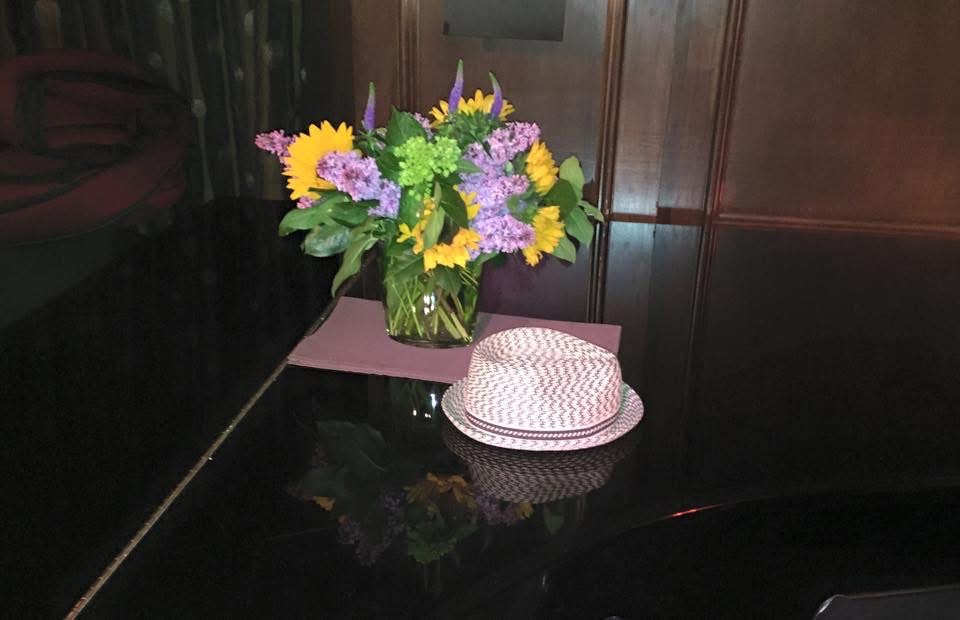 Piano with one of David’s hats – courtesy of Nate Dow While fellow players, supporters and his innumerable fans never got a chance to express their love and gratitude for his contributions to the local, national and global music scene, David's life was celebrated May 19, 2015 in a stirring memorial concert at Scullers Jazz Club featuring more than two dozen of his former collaborators. Memorably, Bob Margolin told the assembled audience, "If you listen carefully, you can still hear David playing the piano."… Indeed. We still do.
Thanks to Johnny Ace, A.J. Wachtel, John A. Brisbin, and Jesse Finkelstein, whose articles included some of David’s words used here. Many thanks to Nate Dow for his contributions.
Touring Band Member with Freddie King, James Cotton, Jimmy Rogers, Ronnie Earl and the Broadcasters, Bonnie Raitt, Otis Rush, and Hubert Sumlin. Performed with Muddy Waters, Otis Spann, John Lee Hooker, Otis Rush, Jimmy Rogers, Buddy Guy, Albert King, Lowell Fulson, Jimmy Withersoon, Big Walter Horton, Rufus Thomas, Big Mama Thornton, Sonny Terry and Brownie McGee, Albert Collins, Arthur "Big Boy" Crudup, Robert Lockwood Jr., Memphis Slim, Hubert Sumlin, John Hammond, Kim Wilson, Junior Wells, Charlie Musselwhite, John Mooney, The Fabulous Thunderbirds, Johnny Shines, Johnny Adams, Billy Branch, Margie Evans, Jimmy Johnson, Fenton Robinson, John Primer, Paul Oscher, Tracy Nelson, Sippie Wallace, Odetta, Levon Helm, Mojo Buford, Snooky Pryor, J. Geils, Jerry Portnoy, Sugar Ray Norcia and Bob Margolin.
|
|

